Showing posts with label Studio Visits. Show all posts

Saturday, September 6, 2014

VL Studio Vist with Marzena Oberc-Habzda

I was borne in Poland, where I lived in historic city of Krakow. My favorite activity as a child were, drawing, painting or creating figures from clay. I always could be found at my desk consumed by my latest art project. I participated in various art competitions, winning various awards.
My grammar school teacher encouraged me to focus on art as a future career. During high school at Liceum Plastyczne , I studied drawing, painting, sculpture and restoration of historic wall frescoes.
Toward the end of high school I have moved with my family to U.S.  After graduation I attended Museum of Fine Arts in Boston, Massachusetts, for continuing education.
I also attended Pair Collage of Art in Hamden, Connecticut. There I studied Graphic Design.
I am captivated, inspired and challenged by various subjects in nature.  My main focus is on nature’s delicate yet powerful beauty, remarkable design and perfect color harmony. I am driven by a need to explore and capture a certain sense of light to evoke desired emotion and inner feeling not easily captured and expressed in words.
I am fascinated with perfect unity, relationship of shapes and harmony of color that nature delivers with such ease and perfection. This creates constant excitement, drive and spontaneous approach to the subject. Inspiration for every painting comes from seeing and experiencing something beautiful, something so captivating that it takes my breath away.
I love painting with acrylics! For health reasons, a while ago, I had to switch from oils to acrylics.
Once I discovered Golden Open Acrylics I never looked back. They offer slower drying time, therefore an ability to be manipulated with ease in order to create oil like appearance. My painting technique does not require  blending of colors, therefore transition from oils was rather quick and easy. I paint with small tiles for color gradually banding them to a desired value, warm or
 cool temperature, manipulating edges and texture to create a desired effect with ease. Because of their quick drying time, acrylics offer instant visual gratification and result. I am representational artist, therefore my painting style requires a specific canvas texture in order to maintain certain control and manipulate the paint to accomplish the desired effect. My favorite painting surface is the Cleassens #13, oil primed , fine weave  linen panel by Sourrce Tek.
Love the gliding ability of Golden Open Acrylics on panel surface. Acrylics allow me to paint faster with very satisfying results. Colors are brilliant, pure and easy to mix and manipulate . The felling I am trying to convey is accomplished in a quick and satisfying manner. I tend to favor cool colors; i.e; blues, purples. My very favorite color now is Naples Yellow.  There are many incredible artists that I admire as most of us do. However there are two artists of the past that made a very strong impression on me when I was still a young child. First one is wonderful Russian painter of late  1800 Ivan Shishkin and the other Franz A. Bischoff. There are so many wonderful artists today that I love and greatly admire, like Richard Schmid, David A. Leffel, Morgan Waistling, Huihan Liu,  Dan Gerhartz, Quang Ho, Sherrie Mc Graw, Karthryn Stats, Jeffery Watts and Scott Tallman Powers just to name a few. I am very gatefull to all of them for there willing to share their knowledge and experiences with the rest of us, therefore helping us become better artists and bystep some of the common mistakes and learning arrors.

Wednesday, August 20, 2014

VL Studio Visit with Milton Wagner

Milton Wagner – Aspen Ironworks
Master Craftsman
www.AspenIronworks.com

 The crisp smell of aspen trees has always reminded me of the Colorado high country cowboy life.  I was born and bred in a small mountain town in southwest Colorado.   The only thing I ever wanted to do was be a cowboy.  My mother had a picture of a three year old me with a rope in my hand chasing after a chicken.  From chickens, I moved on to dogs, calves and occasionally my sister.
I was lucky enough to come from a farming family tree with the occasional cowboy branch.  I grew up on stories told to me by my two favorite cowboy heroes - my great uncle Clem & uncle Henry. Other cowboys I idolized were John Wayne, Louis L’Amour, Tom Mix and the boys from the Ponderosa.

I’ve often been asked why cowboys are my idols and I guess it really boils down to what a cowboy stands for.  The cowboys I was lucky enough to know were loyal, honest and hardworking.  
When I was in high school, I divided my time between metal shop and cow punching for local ranchers. Whenever the ranches needed equipment fixed, I was the go-to person because of my metal-working background.  I learned early on how to use my imagination to envision metal as a great medium.

When I was eighteen, I broke my first horse.  That horse was my best friend and partner in crime for the next 36 years.  Right after high school, I met my lovely wife. While we raised our three children, I worked as an iron worker for money and moonlighted as a cowboy for fun.  In my spare time, I’d gather leftover metal, wood and horseshoes for future art projects.

I started Aspen Ironworks, an eco-friendly metal art studio 15 years ago because I wanted to work for myself & focus more on my art pieces. I work in two main areas - a studio/workshop on the back of my property and under a large oak tree overlooking the horses.  I use the oak tree forge when the weather is too nice to stay indoors.  I use a handmade forge, several pairs of tongs handed down from my grandfather to father and then to me, and two anvils - a 200 pound workshop anvil and an 80 pound vintage farrier anvil which I can transport if I need to.

I started out with individuals cowboys made from leftover rebar and quickly graduated to western scenes.  I thought about what does a cowboy do? A cowboy’s life is simple. Cowboys rope, they ride, and they drink.  My western pieces reflect this lifestyle. I do bar scenes, I do rodeo scenes and I do cattle drive scenes.

I feel my work is unique for three main reasons.  First, my cowboy knowledge is authentic. It's important to me that the story I tell is the right one.  I've been in these situations I craft out of metal.  I've been bucked off a bronco and know which part of the cowboy is last to touch the horse. I've roped cows and know the correct angle of the rope loop. My cowboys hold it at the right angle for roping a cow on the first try. I’ve been on top of the mountain when it's cold and freezing and the only thing you want is a cup of coffee around the campfire. 

Secondly, I believe in doing lifetime work.  I’m putting my name on each of these pieces & I want the people who buy my art to have something that will last them for generations to come. There are metal workers out there who just tack their pieces together and that irritates me. If you're going to do a true work of art, you need to craft it right. Thirdly, I believe in leaving a better world for my children and grandchildren than I had which is why 95% of the materials I use are recycled, reused, or eco-friendly.  I gather used horseshoes from my farrier friends & old metal bits from local farmers and scrap metal shops.  I even have a page on my website for local residents to schedule scrap metal pickups.

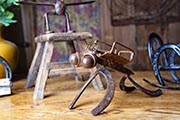
Every piece of my art has a unique story.  For example, each mirror used on my bar scenes is a rearview mirror from a scrapped car or truck.  My chuck wagon base is the bottom of an old broken rototiller.  Recently I created a steampunk bug with ball bearings I had received when we replaced a steel ball mill in a gold mine. The ball bearings start out 8 inches in diameter and they roll around and crush up ore to extract the gold.   By the time I got them, they had been worn down to about an inch across. I saw those and thought they would make great eyes.

I'm really excited about a trio art piece I'm working on right now. I've got a cattle drive scene. I've got a chuck wagon, and I’m in the process of designing the campfire scene. After driving the cattle all day, there's nothing more a cowboy wants than to take a load off and grab a cup of coffee around fire. I’ve already decided how to make the fire. I have some discarded copper plating which I will melt down and then beat back up into flames.

Even though I’m retired from day to day ranching, I still get to play cowboy occasionally.  Twice a year I head to Colorado. I help drive my son’s high-altitude grass-fed cattle up onto their mountain grazing lands in the spring and back down in the fall. Driving the cattle among the aspen trees inspires this old cowboy to come home and preserve that vanishing way of life through lasting sculptures.

“He who works with his hands is a laborer.
He who works with his hands and his head is a craftsman.
He who works with his hands and his head and his heart is an artist.”
~Francis of Assisi

Saturday, July 19, 2014

VL Featured Artist Dawn Waters Baker

Dawn feels like her first language was beauty. That was how her heart was stirred to art. Born and raised a missionary kid she learned to look for it in the cracks and crevices of lives much harder then her own. In college, she learned how to find her own way to express her heart through painting. Dawn’s husband is a gentle gift who likes quiet as much as she does. They have three kids and with them the quiet left. It birthed a joy found in working on what's important and striving for love in all things.


She likes to think of her work as a “glimpse of the mystery.”  The metaphors of life held in branches, cloud wisps and water.  There is something that compels Dawn to paint, not what is literally seen but what is felt.  For her, the window into the spiritual is nature. It seems to be the image that she is invited to pass through into something much richer and deeper and full of beauty.

Her art is collected by many businesses as well as private owners.  Some of which are: Dallas Theological Seminary, Dallas Eye Care Associates, Dallas Baptist University, She currently finished five original drawings for the book, “Why, O God?” published by Crossway books.  She is a member of Artists of Texas. Dawn is affiliated with Mary Tomas Gallery in Dallas Design District, Smith Klein Gallery in Boulder, Colorado and currently with the summer group exhibit at White Stone Gallery in Philadelphia, PA.  Her work has been in National shows including The National Weather Biennale, CIVA Contemporary Images of Mary and Ex Nihilo at Roberts Wesleyan College.  Her work is available internationally through Veritasse based in London, England.


Wednesday, July 16, 2014

Artspan Artist Spotlight with Jean Howard

When did you realize you loved art and wanted to be an artist?
I don't remember exactly when I first wanted to be an artist. 

Who has been your mentor, or greatest influence to date?
My father was an architect and did some watercolor renderings of his projects.  I think that I always drawing.  When I was 13 he gave me some art books and about that time I knew that I wanted to be an artist. He was my greatest mentor.
Who is another living artist you admire and why?

The artists that I admire are Richard Diebenkorn and Hans Halls. I know that they are dead but I am not influenced as much by today's artists.


What is your favorite surface to create work on or to work with? Describe it if you make it yourself.
I like to work on handmade watercolor paper when I do watercolors and canvas for oils.

 Do you have a favorite color palette?
Not a favorite color palette.
 
How often do you work on your artwork? How many hours a week?   
I work in chunks, solid for awhile and then NOT for awhile.

What are your inspirations for your work?  
I am inspired by things that I see, sometimes unexpectedly.

 What is your favorite color in your closet? 
I don't have a favorite color.  I thought about this question a lot. I am more interested in a relationship between colors. My closet reflects this also.

What book are you reading this week? 
I am reading "behind the beautiful forevers" by Katherine Boo.

What is your favorite food? 
I love lobster.

What color sheets are on your bed right now? 
My sheets are beige.

Do you have a passion or hobby other than painting? What is it? 
My other interests include gardening and duplicate bridge.

Who would you love to paint? 
I love to paint the Ocean.


If you were an animal what would you be and why?  
    
I would like to be a seagull to fly around the banks of the ocean.

Share something with us that few people know about you.  
I am a very private person.

If you could live anywhere in the world, where would you live?  
I would love to live in Laguna Beach.

Saturday, July 12, 2014

VL Studio Visit with William Beebe

Art has always been in my blood, but I took a circuitous route in becoming a full-time professional artist.   In my junior year of college I signed up for a portrait painting class hoping to improve my GPA.  Up until then my life had been all about sports.  I had always been a doodler though, drawing in pencil and seeing the world in black and white.  The thought of being an artist never crossed my mind until I discovered the world of oil painting.  My portrait-painting teacher that semester greatly encouraged me and the seed was planted!

After graduating from the University of Maryland with a Studio/Fine Art degree the pragmatic side of me took over.  I was 23 years old, newly married and living in the suburbs of Washington, DC.  I couldn’t find a job in art because I didn’t study graphic arts.  I found myself working as a bookkeeper and then back at the U. of MD for my second degree in Accounting.  Then I spent a year in tax accounting followed by several years as an accountant in private industry.  I never felt like it was my destiny.

In the meantime, my father died suddenly from cancer as my mother was fighting her own long battle with cancer.  My father was the one who had told me to do what makes me happy.  My mother was the one who took me to art galleries and saved my drawings.  They were giving me the gift of developing a life compass.  I was now at a crossroads and that inner compass was pointing me in a new direction. 

My wife, Jen, and I decided to take a much-needed vacation to Maine and it was there that I became inspired to paint!  I came home from that special trip and painted a schooner docked in Boothbay Harbor.  I started painting more, dreaming of living in Maine and painting as a vocation.  Before long we decided to take a leap of faith.

Now I find myself looking back on 24 years of being a full-time artist.  I appreciate every day of “going to work” and am extremely grateful to have been able to pursue my passion of painting for a living. 

The Maine paintings I produced early on ranged from lighthouses, to working waterman scenes, to the small coastal fishing villages and islands.  My work attracted the attention of Mr. Charles Cawley, an avid art collector and the CEO of MBNA, an international credit card company.  He started collecting my work and eventually hired me to become the resident artist for MBNA!


For nine wonderful years I had the honor of having my paintings featured on the cover of MBNA’s quarterly reports.  Along with paintings of their many office buildings around the world, they encouraged me to continue painting Maine scenes for their collection.

Over time I became more narrowly focused on capturing the beauty of the Maine Windjammer fleet.  Hundreds of schooners used to work the Maine waters, hauling lumber and limestone.  I was intrigued by how few of them are left and saddened by the thought that someday they will be gone.  Each ship has a long history, some dating over one hundred years!

Many hours of painting in the smallest of details were spent on each ship.  I wanted to pay tribute to each ship by recording an accurate interpretation of it on canvas to hopefully last for another hundred years.

My maritime paintings have been exhibited in numerous gallery and museum shows throughout the years including the Farnsworth Art Museum in Rockland, ME and at the Coos Art Museum in Coos Bay, OR, where I won a Merit award in the 12th Annual Maritime Art Exhibition.  Additionally my work has been a part of several Marine Masters Exhibitions in Mystic, CT and Thomaston, ME and the 26th Annual International Marine Art Exhibition at the Maritime Gallery at Mystic Seaport.


When we moved to Virginia in 2002, I was a little concerned that I might have trouble finding that same passion for painting that I found in Maine.

Then one day I heard that the state of Virginia had built a replica of an historic wooden pilot schooner named Schooner Virginia.  After doing a little research I found out that it was going to be docked in Portsmouth, VA.  When I walked up the dock and saw the Virginia for the first time I was taken aback.  The tall ship with its beautiful black shiny hull and gold engraved letters on the bow spelling VIRGINIA had grandeur to it. I took hundreds of detail pictures that day in Portsmouth.

I had found new inspiration and immediately started planning a series of paintings featuring the Schooner Virginia.

Every year there is a Great Chesapeake Bay Schooner Race that begins in Annapolis, MD at the Bay Bridge and continues on down the Bay.  I witnessed and photographed the Virginia and the Pride of Baltimore II in a nose-to-nose race under ideal sailing conditions.  It was a powerful moment for me.

During that race I also photographed the Pride of Baltimore II, the Lettie G. Howard out of New York, and other smaller schooners, which sail the waters of the Chesapeake.

My first painting of the Virginia was a large commissioned piece featuring the tall ship cutting through the dark water with speed and grace.  I was honored when approached by the folks at the Schooner Virginia to have reproduction giclee prints made from this painting to help with their annual fundraiser.  We worked closely with the Mariners’ Museum in Newport News, VA to produce these quality prints. 

Subsequently, I completed four more Schooner Virginia paintings in competitive races with sister ships to complete my series.

I’ve discovered that like art, a need to be near the water is in my blood.  Being able to combine the two callings as a maritime artist has turned out to be a dream come true! 

Wednesday, February 19, 2014

Alejandro Castanon Studio Visit Visual Language Magazine


Alejandro is a Mexican born national raised overseas in Spain and Germany. He began his journey into art at the age of nine by sketching comic book covers of Spiderman and other favorite super heroes. In his teens his art became more focused on portraits and he mainly worked in graphite and charcoal. After an eight-year tour in the U.S Air Force as a Civil Engineer he came to call San Angelo, TX his home to help raise his daughter and opened the Vino Dipinte Art Gallery in 2011. Coming back to art was a reawakening for him back to a passion that had been set-aside for several years. Invigorated by the mounds of talent around him Alejandro picked up a paintbrush and began his self-taught lessons into painting. 

Like all artists that set out on a new medium there were mistakes, but from every painting grew a lesson in tone, perspective, light, and contrast. He found inspiration in artists such as Seren Moran, Sarah Stieber, Evelyn Boren, and Leroy Nieman. His style became fixated on the use of color to enhance and compliment his subject matter. Any beginning artist can agree that jumping into the world of colors on canvas or any material is intimidating; there was a challenge and a world of colors that was waiting for him. In 2013 he held his first solo show, aptly named the Colorem Art Show, which featured over 20 large paintings of pop culture icons.  

For Alejandro painting has changed how he views the world around him. A building is not merely a structure but a combination of lines, shapes, and colors. His mind is his canvas and colors are the voice he gives his artwork. Each work must not only be an accurate depiction of his subject but also an energetic and playful demonstration of his paintbrush. His style requires accuracy but also requires a fast pace that frees the painting; lines and marks are spontaneous.


 As the owner of the Vino Dipinte Art Gallery Alejandro has made art his career and handles all aspects of managing his gallery most notably marketing. He has created and managed the gallery’s website, and social media pages as well as coordinated and promoted three major art shows in the past two years. Along side him is Crystal Goodman, a nationally renowned Muralist and mentor. Crystal is the Creative Director of the Vino Dipinte Art Gallery and provides the much needed constructive criticism a young artist needs to hear from time to time.

According to Alejandro, “the art world has evolved in the last five years and more people are connected to art now than ever before but artists are barely learning how to use that connection”.  Alejandro also serves as a City Art Commissioner in San Angelo and has helped coordinate many community events centered on art. “The typical artist relies on his or her ambiguity, and their art is what speaks for them but he or she must join the conversation in order to gain the best knowledge about their fans and potential clients”, he has also conducted Art Marketing Seminars in order to give artists the tools they need to succeed in the evolving art world. San Angelo is a small community with artist in every medium busting at the seams. “The town of San Angelo has a tight community of artists and supporters that are ready and willing to help, it has been a blessing to begin my art career in such an amazing city”. Private collectors as well as the City of San Angelo have commissioned Alejandro for paintings.

His art can been seen at local bars and restaurants across the city as well as his website 

Friday, February 14, 2014

Mary Jane Q Cross Studio Visit Visual Language


Born in 1951, Mary Jane Q. Cross’s life was a life full of questions and a yearning for order. This was the underpinning of Cross’s future career as a Classical Realism painter whose large body of work is marked by logic, cohesion, and an aura of storytelling that is poetic and consoling.
As a Worcester Art Museum School art student in the 1970’s, Cross was a ‘closet Realist’ as she endured the era’s dominant mantle of Expressionism. Reading of formal artists with her shared realism vision – DaVinci, Sargent, Bouguereau, Godward, Mary Cassatt -- was a point of encouragement at this time. Studying such painters, among other Masters of earlier centuries, inspired Cross in her personal quest to acquire the skills of Classical painting.

After 40-plus years of this visual journey, Cross continues to produce a body of work that presents a sense of needed and appreciated refreshment in the midst of modernity’s fast pace. Cross’s resonant theme is of respectfully uncovering the many complex layers of women.  Appealing to both women and men alike, her work presents women’s beauty as a deep comfort and a restful joy, when idealistically and, perhaps, Biblically examined.  In a contemporary culture that perceives the sexuality of women in an increasingly objectified manner, Cross’s work offers a breath of hope. Her work presents a delicate beauty that she believes young women, in particular, are actually striving for – a beauty that, in the artist’s opinion, reflects an image of women as God intended them to be: Creation’s crowning jewels.

“If you do not have life, you cannot give life,” states Cross. “If my work has anything, it has an authentic response to life. My paintings are stories. They depict the quiet rest that comes to a soul only after it has determined to deal with circumstances head-on, with grace and tact instead of grumbling and complaining. My paintings reflect and inspire a determination to focus on beauty, even in the midst of ashes. This is something I have had to live.”

For the past 21 years, a serious right-sided tremor has limited Cross’s ability to hold a brush. Thus, Cross paints with her fingers; whatever minimal brush strokes the artist employs are guided by a prosthetic device. A documentary titled Q.  Cross: The Painter behind the Portraits, on youtube, click to view Documentary  details her journey back to painting in the after-years of the tremor’s on-set. The artist has also compiled a book, Poems of a Painter, Paintings of a Prayer, in which she speaks of how she has come to deal with this physical challenge that she cannot change and, yet, has witnessed a greater dream come out of what were initially tragic circumstances.

The simultaneous heartache and joy that Cross experiences daily is seen in her paintings – and it is heard in the poems that she writes as an accompaniment to each of her works. The combined presentation of painted image and printed word has enriched the meaning of her work.

The public is a telling barometer of the penetrating resonance of the artist’s work. Cross’s paintings are regularly displayed by the Art Renewal Center Salon Exhibitions (where Cross is an ARC Associate Living Master), click for ARC Masters Gallery the International Guild of Realism (where she was awarded Best of Show in 2013), the American Society of Traditional Artists, the Salmagundi Club, and the Allied Artists of America.  

As many as 30,000 people a year also view Cross’s work at outdoor venues. Viewers who cannot afford the originals are still enthusiastically pleased to own limited edition prints. Collectors who can afford these multi-faceted jewels get to live with a palpable part of Cross’s personal vision, crafted with her personal touch. 

Mary Jane Q. Cross www.maryjaneqcross.com builds a body of memorable work in a studio, built by her husband and hugged by New England’s quiet countryside, as she threads the fabric that mirrors her own life into her work. Her quest is a worthy one.


Friday, January 24, 2014

Kathy O'Leary Artspan Interview with Visual Language Magazine


When did you realize you loved art and wanted to be an artist? 
In 1989, having rediscovered I still had my drawing skills (developed from early college experience) I was drawn to painting and drawing again as a release from stresses of my job.  As my skills grew rapidly I decided in 1990 that I wanted to leave my job and work closer to the field of art.  After a year working for the local art’s council, being around art every day, artists, helping curate and hang shows,  I quit to work full time at my own art.  I committed myself to learning as much as I could, to see whether I could do this professionally.  I honed my skills working at first in watercolor, pastel, mono printing, and finally trying oils.  From my first experimentation with oils as a medium (in ‘94), I knew immediately that this was my medium and that the life I wanted was as a painter working in oils.

Who has been your mentor, or greatest influence to date? 
I live in an artistically rich community, surrounded by supportive talented artists, but my greatest influence has come from a circle of local women artists (working in various mediums) I’ve grown close to over the years.  They have supported, encouraged and challenged me (and each other) and together we have grown beyond where our individual dreams could have taken us.

Who is another living artist you admire and why?
The artist (and friend) I admire is a painter named Jim McVicker.  He is now beginning to garner much deserved national recognition for his work.  I admire him for his skills as a painter, his ability to interpret beauty in the landscape, the still-life and the figure. All without any apparent ego, willing to share his thoughts, and open to learning from others.  He works only from life.  His studio was close to mine when I was starting out, and I watched him (and his wife, Terry Oats) come to work everyday to his studio 7am - working in the studio or on location, until the sun set.  He was such a good model for me to learn how you grow as an artist.  Now I see his artistic sensibilities, his drive and commitment to his craft paying off.

What is your favorite surface to create work on or to work with? Describe it if you make it yourself. 
My favorite surface to work on is good quality canvas or linen, double primed, preferably oil primed.

What are your favorite materials to use?
My favorite materials include good quality oil paints (I’m still exploring  colors/brands that work best for what I’m trying to do. My favorite medium (used sparingly nowadays) is Dan Smith Alkyd medium, cut with poppy oil and Gamsol (mineral spirits).  My favorite brushes right now are Windsor Newton hog bristle, flats and brights.


Do you have a favorite color palette?
3 blues - Ultra Marine, Kings Blue, Cerulean
3 reds - Alizarin crimson, Cad. Red med or other Medium red &Transparent Earth Red
3 greens - Sap Green, Veridian, Cadmium green
4 yellows - Raw umber, Yellow Ochre, Cad. Yellow deep, Cad. yellow light (or lemon yellow)

White - Usually Titanium or Titanium/zinc white

How often do you work on your artwork? How many hours a week?
I work on my art, almost daily.  At least 6 days/week, probably 40 - 55 hrs/week.

What is the one thing you would like to be remembered for?
Probably the change I made in mid-life from working in the natural food business to being a professional artist. I’m an example of that fact that with hard work, commitment, and a passion for art, it can be done.  

There are many culprits that can crush creativity, such as distractions, self-doubt and fear of failure. What tends to stand in the way of your creativity?
What stands in my way the most is self-doubt, sometimes fear of failing at what I’m trying to do.

How do you overcome these obstacles? 
I over come this, sometimes more successfully than others, by going to work every day.  Starting a new painting.  By reminding myself it’s about the process and not to allow myself to get immersed in the competitive and comparative mode with other artists.  Going to museums, galleries, reading books on art, all show me how very different we all are as artists, and there are many paths to living an artistically creative life. 

What are your inspirations for your work?
My inspiration for my work first and foremost comes from my travels and  explorations of the landscape in my home state, California.   Next it comes from visiting galleries and museums and seeing all the different takes possible on any one subject.  I try to pay attention to what really touches me at a visceral level.  I’m inspired by those artists who take off on a different style, mode to express themselves, particularly those working with the landscape as their subject.

What is your favorite way to get your creative juices flowing?
Some of my favorite ways to get my juices flowing are:
-Meditate first before starting work for the day.
-Doing a small painting (6 x 8) of some subject (ex: photo of a landscape), or small still life, using 100 brush strokes (or close to it).
-Hanging a large piece of blank paper on my wall and with tempera paints, taking about 30 minutes to paint what ever I’m feeling, using big brushes and bright colors )sometimes totally abstract, sometimes figurative).

Which work of yours is your favorite?  
Right now, it’s “Earth, Air, Fire-Mt. Shasta”. Painted on location it’s one of my newest ones.


Getting to know you Q&A

 What is your favorite color in your closet?    Red

What book are you reading this week?  Richard Schmid’s Alla Prima II
Do you have a favorite television show? Bones, & Antiques Road Show

What is your favorite food? East Indian

What color sheets are on your bed right now?  Green

What are you most proud of in your life? With my husband of 47 years, raising an intelligent, sensitive, hard working, progressive son, who in turn is an amazing parent and marriage partner, and making a successful mid-life career change.

Who would you love to interview?  My long dead great uncle, Willard “Spud” Johnson, a writer and poet, and good friend to writers (D.H. Lawrence) and artists (Georgia O’Keefe) in Taos New Mexico between 1930’s - 1960’s. 

Do you have a passion or hobby other than painting?  No.

Who would you love to paint? The women in my circle of women artist friends.

If you were an animal what would you be and why?  Human

If you were stranded on a desert island and could only take three things, what would they be? A watercolor paint set, paper, some good pot.

Share something with us that few people know about you.  That I have a degree in Social Welfare.

If you could live anywhere in the world, where would you live? Somewhere in central, rural California, close to our son and his family, equidistance to both ends of the state I love to paint, with a home and studio surrounded by several acres of natural, interesting landscape.

http://www.kathyoleary.com/

Friday, January 17, 2014

Kimberly Santini capturing the light with Visual Language Magazine Studio Visit

I’ve always been an artist, even if I’ve not actively labeled myself one. As a child, I doodled animals in the margins of spelling tests and daydreamed of painting murals. My parents indulged me with Ebony pencils and gum erasers, and I covered the backside of reams of paper from my father’s office with drawings. I checked out every book on art in our small town library, and was happiest when creating. I would say that’s still a solid truth. Art infuses every bit of my life.


I have a BFA in Painting, but I think the degree/experience that helped me the most was the BA I earned concurrently in Art History. There is nothing like immersing yourself in masterful artwork, dissecting it, learning about the struggles and challenges of prior generations of artists, and refining your own critical eye. The hours spent in a darkened lecture hall, viewing hundreds of slides, and discussing comparisons and contrasts has helped me immensely in learning to recognize and identify the qualities of “good art.”

As a younger artist, I wanted my paintings to look exactly like my subjects. I worked in hyper realism, literally defining each hair. Gradually I became interested in emotional content and symbology, and began working in a looser, more colorful style, allowing the compositions to tell a story. In graduate school I even spent time doing installations and color field abstracted paintings. Currently I concentrate on building mood through use of expressive color and painting the atmosphere around the subject – and those are the things I’m best known for stylistically.
I paint objects that make me smile. Which means there are a lot of animals in the mix, but also vintage books, old toys, and other odd items that I find delightful. I feel it is mostly important that there is soul in my artwork, whether a physical soul from a breathing creature or the soul that cherished memories carry.

Painting animals means I rely on photographs as main sources for my paintings. However, working exclusively from photographs can seriously limit an artists’ options – after all, the camera has only one “eye” and is very skilled at lying. So it’s important to spend lots of time looking at my subjects, studying the light, and trying to work from a visual memory (or life) as much as possible. There is no substitute for knowing your subject matter.

My studio is in my home, which gives me great flexibility to work when the opportunity presents itself. 
I flex my days around my family’s needs – grabbing about 8-10 hours in the studio each day, 6 days every week. Approximately 80% of my time is spent doing things other than making art – maintaining my mailing list, generating marketing materials, managing inventory, handling client correspondence, building lesson plans and class content and singlehandedly doing all the grunt work involved in running a small business.


I’ve been a daily painter since 2006, and create at least 4 new pieces, usually Alla Prima, each week. The commitment to painting daily has taught me discipline and perseverance, often in the face of other obstacles that might otherwise have kept me out of the studio. The act of pushing paint regularly has helped me to work smarter and also freed me up to make – and learn from – a huge variety of mistakes! And painting daily has been a great work ethic model for my kids to see – they have grown up creating (or doing homework) alongside me.

I work in acrylics, mostly because they are fume free (an important aspect when working in one’s home) and quick drying (another important aspect when there is a constant flow of kids coming and going).  I’m also an impatient artist, and acrylic paints enable me to move at a faster pace. When I get an idea, I want to get immediately to the paint – no preliminary sketches or planning – which can mean lots of corrections on the painting. This can be a good thing in that the spontaneity remains visible in the finished piece, but it can also be a detriment when a composition fails due to incomplete planning or lack of thorough thought. And again, acrylics lend themselves perfectly to working in this fashion.

I’m also active in my community – I volunteer at local schools, teach art journaling, and help with programming at my local library. On top of all this, I manage an active exhibition calendar, share my art at juried events around the country and travel to teach multi-day painting workshops.

I wouldn’t have it any other way – days spent playing with pools of color, and getting to share my passion with my family and the community of fans that’s built up on the internet. It’s a great gig!


I am accepting a limited number of commission requests for 2014, including figural and animal portraits. My daily paintings can be seen at http://www.paintingadogaday.com and can be reached via email at ksantini@turtledovedesigns.com . Please follow me on Facebook, where I share in-process photos of paintings on my easel, among other art-related things .
https://www.facebook.com/KimberlyKellySantini?ref=hl


Friday, January 10, 2014

Glenn Moreton Visual Language Artspan Studio Visit

Painting and drawing has always been an essential part of my life.  My aunt remembers me as a toddler propped up on a chair so that I could reach the blackboard that my grandmother had on her kitchen wall, spending hours drawing with colored chalks.  Even during later times of my life when other priorities had taken over and I was not following my creative urges, art was still an essential—albeit suppressed—part of my life.  Even then, my bottled-up compulsion to be an artist was omnipresent (and making me miserable).    It seemed as if something inside me was fighting relentlessly to emerge.   Finally in 1985,after years of skirting around this creative need, I acquiesced and began painting professionally.  I have enjoyed making up for lost time ever since!


Composition:


When I paint, my primary goal is to create a composition that is aesthetically exciting.  The typical viewer of photorealist or hyperrealist art will first be impressed with the often startling realism recreated in these genres of paintings—the striking reflections in a storefront window, the drama created by carefully placed shadows, or the flashy rendering of an automobile.  Sometimes I find that photorealist/hyperrealist painters can duplicate reality with a technical facility that is awe inspiring, but their paintings may to have little to offer to the viewer beyond that technical slickness.  Like all such artists, I attempt to create a technically sharp realistic image, but contrary to what one may suspect, that is not my chief preoccupation:  composition is what fascinates me.  To me, a complicated, tenuously, carefully balanced composition is extremely satisfying and contributes more deeply to the overall power of the work than do mere flashy rendering techniques alone.  


My Process:

A major part of my process is selection of the scene to be painted.  I go to numerous locales, take countless photos and examine them, combine them, etc. often taking months until I find the right combination of visual elements, the right composition.  My paintings are not mere reproductions of these photographs.  I alter, rearrange, distort, remove, and simplify design elements according to the needs of my composition.  My compositions always make use of visual rhythms--often through the repetition of similar shapes, through the contrast of vertical against horizontal elements, and through balancing of elements by use of color relationships. 

Often--but not always--I briefly project slides of my photos onto the canvas, using projection as an initial tool in my painting process.  Artists (e.g., van Eyck, Holbein, Caravaggio, etc.) began making heavy use of such optical tools early in the Renaissance, and have continued ever since.  I project only a rough outline, after which, I continue with a more detailed freehand drawing .   Not until this initial drawing is made do I begin painting.  As I paint, I constantly change the drawing as I proceed, often distorting elements of the drawing/painting in order to enhance the composition, or to pull the viewer’s eye into the work.  


With my focus on drawing, it is not surprising that a specific characteristic of my process includes careful attention to line work.  Loving lines and the visual energy that they project, I carefully outline all of the objects in my paintings, occasionally coloring the line in a hue that contrasts to the color of object, and using strong lines on outside edges of objects, and weaker lines on internal edges of objects--all techniques to better define how the object cuts through space and to make that image visually “pop.”  

Another characteristic of my process is that I use the paint as both an opaque and a transparent medium (e.g. using glazes to create specific effects such as soft shadows, objects viewed through glass, the haze on distant elements in the landscape, etc.).  As a quickly drying medium, acrylic paints facilitate the use of these dual techniques.


My Subjects:

It may surprise some people to learn that initially I pay little attention to the subject content of my painting.  When selecting a subject that I am going to paint, I choose one with elements that will work aesthetically into an exciting composition.  After that, I try to select subjects that suggest a distinctive mood that is representative of that particular locale; I try to give the observer a sense of place (though generally I try to avoid using obvious landmarks).  Another characteristic of my works is that often they combine a hodgepodge of seemingly unrelated, contrasting subject components that blend together in a surprisingly unified whole.

I intentionally avoid consciously selecting my subject matter along political, social, or philosophical themes.  Such calculated depiction of the artist’s viewpoint may seem heavy-handed and risks trivializing more profound subliminal messages.  Also I avoid overanalyzing the subject content of my work.  For me, nothing is more tedious than hearing artists drone on and on about the “profound” meaning of their work.  Artwork should speak for itself.  I find that when an artist designs a work to project a specific point of view or a very personal esoteric subject, the viewer’s experience is overly predefined and limited.


Yet, even though I intentionally avoid painting that overtly expresses a specific viewpoint, I must admit that I when I look at my completed paintings, I do find that my works do tend to spontaneously project certain themes nevertheless.  I find that these themes are all the more interesting, powerful, and universal because of the fact that they have evolved unconsciously and unintentionally.  One recurrent theme that I find in much of my work is that of the dynamics of change with the passage of time.   Another theme is the juxtaposition of the urban environment’s complexity with that same setting’s role as a human environment.   Finally, I find that my work often celebrates scenes that are uniquely American and typical of the U.S urban landscape.  

Friday, January 3, 2014

Photography Interview Tom Peterson, Artspan, VL Magazine January 2014

I took early retirement from The Hartford Financial Group in September of 2003.  That year, I devoted myself to learn and develop as a Documentary and Fine Arts photographer.  I was originally influenced by the life and photography of Eugene Atget, the French photographer whose work concentrated on “Old” Paris during the early 20th Century.  Since 2005, I have dedicated myself to photographing the disappearing sections of Connecticut cities and, more recently, New York’s 5th Avenue.

I generally find places that are in a state of change and often return to them. The more I return, the more I see. That familiarity provides me with opportunities to create unique sets of images and themes.

Many of my photographs focus on an abstract view of every day structures and close-up subjects we often pass by, but rarely notice.   My objective is to find and photograph the uncommon within the commonplace.  


The photographs included in my portfolio, “Around Here”, are part of an ongoing series taken while walking along side streets, back alleys, and vacant buildings in Connecticut’s urban centers.  These particular photographs were taken in once vibrant, industrial neighborhoods that have been left in a state of urban decay.

I have imagined myself an archeologist finding small pieces of abstract art that have gone unnoticed.  Each subject was selected for its vibrant color, shape and texture.  I share any success with my partners, “Time” and “Weather”. 

“Around Here” is one of six portfolios that are currently on my Artspan website, 


Saturday, November 9, 2013

Visual Language Magazine Artspan Studio Visit with Kari Tirrell


I never intended to be a professional artist.  Like many artists, I drew constantly throughout my childhood.  Although my lack of formal art education has not been a hindrance for me, had I known I’d become a professional artist someday I probably would have chosen to focus on art in school.  At that time, though, art didn’t seem to be a good career choice.  Being a “starving artist” didn’t appeal to me, and I didn’t want to teach, so drawing was more of a habit.  It was something I felt compelled to do, but had no intention of doing anything with it.

Many years later, when my kids were at an age where they were becoming independent and I started thinking about what I was going to do with my time, I decided to try painting and it completely changed my life.  I painted abstracts in acrylic and sold them on eBay.  It was great validation, super fun to find people liked my work enough to bid on it, and even more amazing to think about people in countries around the world hanging my work on their walls.

Colors by Kari Tirrell
Eventually, I switched from abstraction to realism, which also caused a switch in medium.  I was now painting in oils.  However, soon after changing to oils I stumbled upon the amazing pastel work of Alicia St. Rose.  I had no idea such detail could be achieved with soft pastels, and I knew I had to try it.  Her process looked painfully tedious, and I knew I didn’t have the patience to work like that, so I purchased various soft pastels, pastel pencils, and a variety of papers and set out to develop my own process.  It took a lot of trial and error, but I was able to figure out how to get the results I wanted.

Banana Bread by Kari Tirrell
Once I started painting realism, I realized brick and mortar galleries would be a better fit for my work than selling online.  I had no idea how to go about getting into galleries, so I created a plan: I would join art organizations, get into their shows, and build up a resume.  I decided three years would be a reasonable amount of time to give me the experience and a good enough resume where I could feel comfortable approaching galleries.

I painted specifically for exhibitions, focusing on composition and lighting to make sure I was able to enter at least one award worthy painting into each show.  I believe this focus helped improve my compositional ability as well as my painting technique.  The awards my work received were validation I was heading in the right direction.  My three year plan was successful, and although my first gallery ended up not being a great fit, it was a good learning experience in choosing the right gallery.  I currently work with several excellent galleries, and I truly value my relationships with them.

Train Wreck by Kari Tirrell
While I started my pastel career painting people and animals, over time I’ve gravitated toward painting still life, and I really enjoy it.  I like the challenge of creating an interesting composition with inanimate objects.  I like painting various surfaces (wood, glass, ceramic, etc.) and getting them to read accurately.  My compositions have grown more complex; I like paintings that invite the viewer to stay awhile, something that will keep their interest over time.  On the other hand, I also enjoy creating simple compositions, particularly when I can experiment with changing the scale of the objects.

I like to explore themes, repeatedly painting the same subject in different ways until I feel I’ve said as much as I want to say, and then I move on to something else.  I typically enjoy painting things that touch on nostalgia.  Old toys are a favorite.  Right now I’m working on compositions with candy. 

I recently started working in oils again, in addition to pastels.  My work is very time consuming, regardless of medium, but I feel so lucky to be able to do what I do.  It is definitely work; mostly challenging, and sometimes even frustrating.  But painting satisfies my soul as no other job could, and I plan on doing it as long as possible. 

Traffic Jam by Kari Tirrell
A self-taught artist, Kari Tirrell spent her formative years drawing people and animals in graphite, charcoal, and ink.  She won her first award in an art contest at age 11.  After many years of drawing, Kari changed direction and started painting abstracts in acrylic, selling her work to collectors around the globe.  After returning to realism, Kari’s work has been juried into many regional, national, and international exhibitions, and has received numerous awards.  She lives in Gig Harbor, Washington, and is a signature member of the Pastel Society of America and the Northwest Pastel Society,  and a Distinguished Pastellist with the Pastel Society of the West Coast.  Her work can be found at Meyer Gallery in Santa Fe, NM, Elliott Fouts Gallery in Sacramento, CA, American Art Company in Tacoma, WA, and Kirsten Gallery in Seattle, WA.

Saturday, November 2, 2013

Visual Language Artspan Interview with Robert Fiacco.


Visual Language Artspan Interview

When did you realize you loved art and wanted to be an artist? When I was about 11 years old my father started a small business that involved selling reproductions of famous paintings; we had dozens of these paintings hanging all over the place.  I absolutely loved these paintings and would spend hours copying them; I have been painting ever since.

Who has been your mentor, or greatest influence to date?  I don’t recall having a mentor per se; I have had outstanding teachers early on but never a consistent mentor.  Winslow Homer has been a huge influence.  I am especially impressed that he was able to transition from illustration to fine art.

Who is another living artist you admire and why?  Jasper Johns; his paintings are so unique and intellectually challenging.

What is your favorite surface to create work on or to work with? Describe it if you make it yourself.  I love texture in painting; I primarily work with canvas that is sized with heavy amounts gesso.

B-24D Pelosti Raid by Robert Fiacco

What are your favorite materials to use? I primarily use oil paint and Liquin Impasto and Olepasto mediums.  I am starting to explore encaustic.

Do you have a favorite color palette? I prefer a cooler palette but I really don’t limit myself.

How often do you work on your artwork? How many hours a week? I only average about 5-15 hours a week.

What is the one thing you would like to be remembered for?  Honesty and creativity in my artwork.

There are many culprits that can crush creativity, such as distractions, self-doubt and fear of failure. What tends to stand in the way of your creativity? Often financial concerns get in the way.  For example, I often take commissions, which are not very creative endeavors since the customer is usually very specific in what they want hence there isn’t much latitude for creativity.

Hellcat Formation by Robert Fiacco
How do you overcome these obstacles?  I try to be as frugal as possible and maximize my exposure through juried shows/art fairs.  I have been successful in selling some of my artwork, including giclee reproductions without relying too much on commissions.


What are your inspirations for your work? I love narratives or stories of amazing feats.  I prefer to illustrate dramatic events that occurred.  I will research the specific event, learning the life stories of the people involved, and the exact details of the event.  When you fully understand the people and the event; it is quite inspiring to paint it.

What is your favorite way to get your creative juices flowing?  I have two loud kids; sometimes, just having it quiet is enough.

Return to Happy Valley by Robert Fiacco
Which work of yours is your favorite?  Oriskany Rendezvous is my favorite.  I feel that the painting is dramatic and conveys a sense of foreboding associated with war.      


Getting to know you Q&A

What is your favorite color in your closet? Light blue.
What book are you reading this week? “Art and Perception”.
Do you have a favorite television show? Not really; however, I often watch English or Spanish league soccer games.
What is your favorite food? Italian.
What color sheets are on your bed right now? Tan.
What are you most proud of in your life? Taking care of my family.
Who would you love to interview? Larry Gagosian.
Do you have a passion or hobby other than painting? What is it? Soccer.
Who would you love to paint? Nicole Kidman. 
If you were an animal what would you be and why? A golden eagle; being able to fly…can’t imagine anything better than this. 
If you were stranded on a desert island and could only take three things, what would they be?  A book, sketchbook, & my guitar.  
Share something with us that few people know about you.  I believe in ghosts.
If you could live anywhere in the world, where would you live? Spain.